

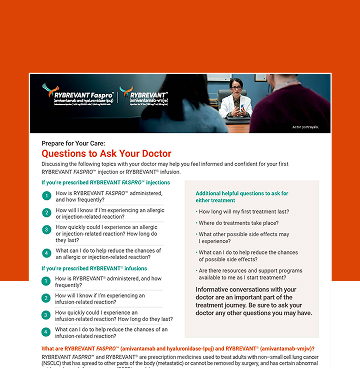
Man and woman meeting with a doctor; questions to ask your doctor

About non–small cell lung cancer
(NSCLC)

Actor portrayals.

If you or someone you care for has been diagnosed with EGFR+* NSCLC, check out the information below to better understand treatment options with RYBREVANT FASPRO™ or RYBREVANT®.

About NSCLC

NSCLC is the most common type of lung cancer—it makes up about 85% of all lung cancer cases.

Lung cancer, including NSCLC, occurs when cancer cells form into tumors in the tissues of the lung. When cells from the tumor travel through the body, the cancer spreads. When this happens, it’s called “advanced” or “metastatic” cancer.

Learn more about your NSCLC with biomarker testing

Once an NSCLC diagnosis has been made, biomarker testing is used to help your doctor identify the treatment that best fits your needs. A biomarker is a sign in your body that helps doctors understand your health and your cancer. By testing for certain biomarkers, your doctor can understand what kind of genetic change, or mutation, your cancer has. Your doctor will then use that information to choose the most appropriate treatment.

For example, if tests show that your cancer has certain changes—like EGFR exon 19 deletions, exon 21 L858R substitution mutations, or EGFR exon 20 insertion mutations—then RYBREVANT FASPRO™ or RYBREVANT® might be a good option for you. Be sure to ask your doctor about biomarker testing at your next appointment.

Find out more about EGFR mutations

A protein called EGFR (epidermal growth factor receptor) is found on both healthy cells and cancer cells. This protein is important because it helps healthy cells grow and survive. But sometimes harmful changes in EGFR proteins, known as mutations, can make cancer cells grow and spread in the body.

RYBREVANT FASPRO™ and RYBREVANT® can be used by itself or with other medicines to treat advanced NSCLC that has certain EGFR mutations and has spread to other parts of the body (metastatic) or cannot be removed by surgery:

EGFR exon 19 deletions or exon 21 L858R substitution mutations, which account for 80% to 90% of all EGFR mutations in NSCLC.

EGFR exon 20 insertion mutations, which are rare but still the third most common EGFR mutations in NSCLC.

Find the EGFR+ NSCLC treatment that may fit your needs

Ask your doctor if one of these treatment options may work for you.

This is my first time
receiving NSCLC treatment

I have EGFR+ NSCLC with exon 19 deletions or
exon 21 L858R
substitution mutations.

I have EGFR+ NSCLC with exon 20 insertion mutations.

I already received a
treatment other than
RYBREVANT FASPRO™ or RYBREVANT®

I have EGFR+ NSCLC with exon 19 deletions or
exon 21 L858R
substitution mutations.

I have EGFR+ NSCLC with exon 20 insertion mutations.

Frequently asked questions (FAQs) about NSCLC & RYBREVANT FASPRO or RYBREVANT®

Here are some questions that people often have when facing non–small cell lung cancer and considering treatment with RYBREVANT FASPRO™ or RYBREVANT®. If you have other questions, check the full .

The 2 most common types of lung cancer are non–small cell lung cancer (NSCLC) and small cell lung cancer (SCLC). The difference between these types is how the cancer cells look under a microscope and the different treatments approved for use for each. NSCLC is the most common type of lung cancer. About 85% of all lung cancer cases are NSCLC.

A protein called an epidermal growth factor receptor (EGFR) is found on both normal cells and cancer cells. It drives cells to survive and grow. EGFR mutations may cause cancer cells to grow and spread to other parts of the body.

RYBREVANT FASPRO™ and RYBREVANT® are made of antibodies that target EGFR mutations. To help determine if RYBREVANT FASPRO or RYBREVANT® is right for you, your doctor may perform a biomarker test. These tests can check your tumor for different biomarkers, including EGFR, and can help guide your doctor to the appropriate treatment.

*Exon 19 deletion or exon 21 L858R substitution mutations.

Man and woman meeting with a doctor; questions to ask your doctor

Doctor Discussion Guide

Tips and example questions for having a helpful discussion with your doctor.

Elderly woman smiling happily outdoors

Savings & support

Once prescribed RYBREVANT FASPRO™ or RYBREVANT®, connect with a Care Navigator for your support needs.